



Chicken feed pellet production efficiency directly affects the operating cost, output, product quality, and profitability of a poultry feed plant. A production line that uses high-performance equipment but has poor material preparation, unstable feeding, inefficient cooling, or frequent downtime may still struggle to achieve its designed capacity.
Improving efficiency is therefore not simply a matter of increasing the speed of the pellet mill. It requires optimization of the entire production process, from raw material receiving and grinding to batching, mixing, conditioning, pelletizing, cooling, screening, packaging, and storage.
A well-designed chicken feed production line should maintain a stable material flow while minimizing energy consumption, production losses, manual intervention, and equipment downtime. The selection and operation of the chicken feed pellet mill are particularly important, but other equipment and process parameters must also be properly matched.
This article explains practical ways to improve chicken feed pellet production efficiency and provides guidance for designing or upgrading a complete chicken feed pellet production line.
1. Start with Proper Feed Formula Design
The first step toward efficient pellet production is a suitable feed formula.
Chicken feed may contain corn, wheat, soybean meal, rice bran, wheat bran, fish meal, vegetable protein sources, minerals, vitamins, amino acids, oils, and other ingredients. Different poultry growth stages require different nutritional formulas.
For example, broiler starter feed, broiler finisher feed, layer feed, and breeder feed may have different requirements for protein, energy, fiber, calcium, phosphorus, and other nutrients.
An inefficient formula can make pellet production more difficult. Excessive fiber may reduce pellet mill throughput, while high levels of oil or sticky ingredients can affect material flow and pellet formation.
Before production begins, the formula should therefore be evaluated for:
- Raw material particle size
- Moisture content
- Fiber level
- Oil and fat content
- Protein sources
- Mineral content
- Pellet diameter requirements
- Required pellet durability
- Conditioning characteristics
A feed formula designed for both nutritional performance and good processing characteristics can help improve production stability.
2. Maintain Consistent Raw Material Quality
Raw material quality has a direct influence on production efficiency.
Corn, wheat, soybean meal, rice bran, and other ingredients should be stored under suitable conditions to prevent excessive moisture, mold, contamination, and deterioration.
Raw materials with inconsistent moisture can create significant problems during grinding, mixing, conditioning, and pelletizing.
For example, excessively wet material may reduce grinding efficiency and cause unstable pellet formation. Extremely dry material may require additional moisture or steam during conditioning.
A professional feed plant should establish incoming material inspection procedures covering:
- Moisture
- Impurities
- Particle size
- Bulk density
- Storage condition
- Mold contamination
- Foreign materials
Stable raw material quality allows the production line to operate with more consistent settings and reduces unnecessary adjustments.
3. Improve Raw Material Cleaning
Cleaning is another important step in improving production efficiency.
Foreign materials such as stones, metal particles, ropes, plastic, dust, and other impurities can enter the feed production system with agricultural raw materials.
A cleaning screen and magnetic separator can help remove unwanted materials before they reach the crusher, mixer, or pellet mill.
This provides several benefits:
- Protects downstream equipment.
- Reduces unexpected downtime.
- Improves feed quality.
- Reduces contamination.
- Extends the service life of wearing components.
Removing large impurities before grinding can also prevent blockages and improve the stability of the entire material-handling system.
4. Optimize Grinding Efficiency
Grinding is one of the most important processes before pelletizing.
Chicken feed ingredients need to be reduced to a suitable particle size so that they can be mixed uniformly and formed into stable pellets.
A hammer mill is commonly used to grind corn, wheat, and other grains.
However, excessively fine grinding is not always the best solution.
If the material is ground too finely, the grinding energy consumption may increase significantly. At the same time, excessive fines can create dust and may negatively affect production economics.
If the particles are too coarse, mixing uniformity and pellet quality may suffer.
Therefore, the grinding process should be adjusted according to:
- Feed formula
- Chicken age
- Pellet diameter
- Raw material characteristics
- Required pellet durability
- Chicken feed pellet mill specifications
A properly selected screen size and suitable hammer mill operating speed can help achieve the desired particle size while controlling energy consumption.
5. Use Accurate Automatic Batching
Accurate batching is essential for both feed quality and production efficiency.
Small deviations in ingredient quantities can affect the nutritional composition of the finished feed. Manual weighing can also increase labor requirements and reduce production consistency.
An automatic batching system can improve efficiency by controlling the addition of different raw materials according to the programmed formula.
A typical batching system may include:
- Storage bins
- Weighing hoppers
- Load cells
- Screw conveyors
- Gates
- Automatic control software
The system can accurately weigh major ingredients and smaller additives according to the production recipe.
Automatic batching also makes formula changes easier. Operators can select the appropriate formula through the control system rather than manually calculating and weighing every ingredient.
6. Improve Mixing Uniformity
After batching, the ingredients need to be mixed evenly.
Poor mixing can lead to nutritional variation between pellets. Some pellets may contain more protein or minerals than others, while others may contain excessive amounts of certain ingredients.
A suitable feed mixer should provide uniform mixing within a reasonable cycle time.
The following factors can influence mixing efficiency:
- Mixer type
- Mixing time
- Batch size
- Ingredient particle size
- Liquid addition
- Mixer loading ratio
- Ingredient sequence
For formulas containing oil, molasses, or other liquid ingredients, the liquid should be distributed evenly rather than added too quickly in one location.
An optimized mixing process reduces production time while maintaining feed uniformity.
7. Control Moisture Before Pelletizing
Moisture management is often overlooked when improving pellet production efficiency.
The moisture level of the feed entering the pelletizing process affects:
- Pellet formation
- Pellet durability
- Energy consumption
- Die loading
- Throughput
- Cooling performance
The ideal moisture level depends on the raw materials and production process.
If the feed is too dry, the material may be difficult to compress and pellet quality may decrease. If the feed contains excessive moisture, pellet formation can become unstable and the cooling system may need to remove more water.
Moisture should therefore be monitored throughout the process instead of being controlled only after pellet production.
8. Use Steam Conditioning Effectively
Steam conditioning can significantly improve pelletizing efficiency.
During conditioning, steam is introduced into the feed mixture before it enters the pellet mill. Heat and moisture soften the material and improve its ability to form pellets.
Effective conditioning can provide several benefits:
- Better pellet formation
- Higher pellet durability
- Reduced fines
- Improved throughput
- Lower mechanical load
- More stable pellet quality
However, simply adding more steam does not automatically improve efficiency.
The amount and quality of steam should be matched with the feed formula and production capacity.
The conditioning time, steam pressure, moisture, temperature, and material flow should be controlled properly.
For formulas with high fiber or difficult-to-pelletize ingredients, effective conditioning becomes even more important.
9. Select the Right Chicken Feed Pellet Mill
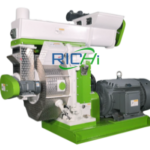
The chicken feed pellet mill is the core machine in many poultry feed production lines, and its configuration has a major effect on production efficiency.
A pellet mill should be selected according to the required capacity, feed formula, pellet diameter, raw material characteristics, and operating conditions.
Important factors include:
Capacity
The rated capacity of the pellet mill should match the capacity of the entire production line.
If the pellet mill is too small, it becomes the bottleneck. If it is significantly oversized, the equipment may operate below its optimal loading level.
Die Diameter and Pellet Size
Different chicken feeds may require different pellet diameters.
Broiler feed, layer feed, chick feed, and other poultry feeds may use different pellet specifications depending on age and feeding requirements.
The die should therefore be selected according to the desired pellet size and material characteristics.
Compression Ratio
The compression ratio affects pellet formation and should be matched to the feed formula.
A suitable die configuration can improve pellet quality while maintaining reasonable throughput.
Drive System
A reliable drive system helps maintain stable operating conditions under changing loads.
The motor, gearbox, main shaft, bearings, and other drive components should be properly matched to the machine capacity.
(Learn more:https://richipelletizer.com/chicken-feed-pellet-machine-for-sale)
10. Maintain Stable Feeding to the Pellet Mill
Even a high-performance chicken feed pellet mill cannot operate efficiently if the material supply is unstable.
The pellet mill should receive a continuous and uniform flow of conditioned feed.
An unstable feeding rate can cause:
- Fluctuating motor load
- Reduced production capacity
- Uneven pellet quality
- Increased energy consumption
- Die blockage
- Mechanical stress
A variable-frequency feeding system can help regulate the feed flow according to the operating load.
Automatic load monitoring can also allow the control system to adjust feeding speed when the pellet mill load changes.
Stable feeding is one of the simplest ways to improve real-world pellet mill efficiency.
11. Keep the Die and Rollers in Good Condition
The die and rollers are critical working components of a pellet mill.
As they wear, pellet quality and production efficiency may gradually decline.
Common signs of excessive wear include:
- Reduced capacity
- Increased energy consumption
- More fines
- Irregular pellet shape
- Difficulty maintaining the required pellet size
- Unstable machine load
Regular inspection can help identify wear before it causes major production problems.
Operators should check:
- Die holes
- Roller surfaces
- Roller bearings
- Die fixation
- Roller clearance
- Lubrication
- Abnormal vibration
Timely replacement or maintenance of worn components can prevent efficiency losses.
12. Optimize Roller Adjustment
The gap between the die and rollers is another important operating parameter.
If the roller clearance is not properly adjusted, the pellet mill may experience unstable production.
An excessively large gap may reduce compression efficiency, while an excessively small gap may increase wear and mechanical load.
The appropriate adjustment depends on the pellet mill design, feed formula, die condition, and operating parameters.
Operators should follow the manufacturer’s recommended settings rather than making arbitrary adjustments.
13. Improve Pellet Cooling Efficiency
Fresh pellets leaving the pellet mill are hot and contain relatively high moisture.
They need to be cooled and stabilized before screening and packaging.
A counterflow cooler is commonly used in larger chicken feed production lines.
An efficient cooling process should:
- Reduce pellet temperature
- Reduce moisture
- Improve pellet durability
- Prevent condensation
- Prepare pellets for screening and packaging
If cooling capacity is insufficient, the entire production line may need to slow down.
Therefore, the cooler should be matched with the output of the pellet mill.
14. Reduce Fines Through Efficient Screening
After cooling, pellets are normally screened to separate qualified pellets from fines and oversized particles.
Excessive fines indicate that something may be wrong with the production process.
Possible causes include:
- Poor conditioning
- Incorrect die compression ratio
- Excessive pellet moisture
- Insufficient cooling
- Worn die or rollers
- Excessive mechanical handling
- Improper screening
Fines can often be returned to the production process, but excessive recycling increases energy consumption and reduces effective output.
Improving pellet durability is therefore more efficient than simply recycling large quantities of fines.
15. Use a Crumbler for Young Chicken Feed
Young chickens may not be able to consume standard-sized pellets efficiently.
In this case, pellets can be processed through a crumbler to produce smaller particles.
A typical process may be:
Pelletizing → Cooling → Crumbling → Screening → Packaging
The crumbler should be properly matched with the pellet production capacity.
If the crumbler becomes a bottleneck, the pellet mill may need to reduce its output even though the pellet mill itself has sufficient capacity.
This illustrates why production efficiency must be considered at the system level rather than focusing on one machine.
16. Improve Material Conveying
Material conveying equipment connects every processing stage.
Poor conveyor design can create hidden bottlenecks.
Common problems include:
- Excessive transfer distance
- Too many transfer points
- Material accumulation
- Blockages
- Unstable feeding
- Excessive dust
- High energy consumption
A good factory layout should minimize unnecessary material movement while allowing sufficient maintenance space.
Bucket elevators, screw conveyors, belt conveyors, and other conveying systems should be selected according to material characteristics and production capacity.
17. Reduce Unnecessary Manual Operations
Manual operation can become a major limitation as production capacity increases.
Operators may need to manually monitor:
- Raw material feeding
- Batching
- Mixing
- Pellet mill load
- Steam supply
- Cooling
- Packaging
- Equipment alarms
Automation can reduce repetitive manual work and improve consistency.
A centralized control system can integrate multiple production processes and provide operators with real-time information.
For example, the system can monitor:
- Motor current
- Temperature
- Material flow
- Batching weight
- Steam conditions
- Equipment status
- Alarm information
This makes it easier to identify production problems before they result in major downtime.
18. Use Variable Frequency Drives
Variable frequency drives, or VFDs, can improve process flexibility.
They can be used to regulate the speed of:
- Feeders
- Conveyors
- Fans
- Pumps
- Some grinding systems
- Other auxiliary equipment
For example, the feeder speed can be adjusted according to the load of the chicken feed pellet mill.
Instead of operating at a fixed speed, the production system can respond to changing material conditions.
This can improve stability and reduce unnecessary energy consumption.
19. Match Equipment Capacity Across the Entire Line
One of the most common causes of low production efficiency is capacity imbalance.
For example, a pellet mill may theoretically produce 10 tons per hour, but the actual production line may only achieve 6–7 tons per hour because the grinding, mixing, cooling, screening, or packing systems cannot keep up.
A balanced production line should consider the capacity of:
- Raw material receiving
- Cleaning
- Grinding
- Batching
- Mixing
- Conditioning
- Pelletizing
- Cooling
- Screening
- Crumbling
- Packaging
- Storage
Each stage should be designed around the target production capacity.
20. Reduce Equipment Downtime Through Preventive Maintenance
Unexpected equipment failures can have a greater impact on production efficiency than small differences in machine speed.
Preventive maintenance should be incorporated into daily production management.
Important maintenance tasks include:
- Lubricating bearings
- Checking belts
- Inspecting gearboxes
- Checking electrical connections
- Inspecting die and rollers
- Cleaning equipment
- Checking steam lines
- Inspecting conveyors
- Replacing worn components
Spare parts should also be prepared for critical components.
A planned maintenance shutdown is usually easier to manage than an unexpected breakdown during peak production.
21. Improve Dust Collection
Dust is common in feed plants, particularly during raw material receiving, grinding, mixing, conveying, and screening.
A suitable dust collection system can improve the working environment while reducing material losses.
Dust collection can also help keep equipment and electrical components cleaner.
Important dust-producing areas should be identified during production-line design.
Effective dust control contributes to:
- Cleaner production
- Reduced material loss
- Better working conditions
- Lower maintenance requirements
- Improved plant management
22. Optimize Packaging and Storage
Packaging can become another bottleneck after pellet production.
If the pelletizing system produces material faster than the packing system can handle, finished feed may accumulate and eventually force the production line to slow down.
The packing machine should therefore match the production capacity.
The storage system should also provide sufficient buffer capacity.
Proper storage helps protect finished chicken feed pellets from moisture and contamination.
23. Train Operators Properly
Equipment performance depends heavily on operator skills.
Operators should understand the relationship between raw material characteristics, feed formula, conditioning, pellet mill load, pellet quality, and cooling.
Training should cover:
- Normal operating procedures
- Equipment adjustment
- Pellet quality inspection
- Die and roller maintenance
- Lubrication
- Safety procedures
- Alarm handling
- Emergency shutdown
- Basic troubleshooting
A well-trained operator can often identify early signs of abnormal operation before the problem causes significant downtime.
24. Monitor Key Production Indicators
Production efficiency should be measured rather than estimated.
Useful indicators include:
- Tons produced per hour
- Energy consumption per ton
- Pellet durability
- Percentage of fines
- Moisture content
- Downtime
- Labor requirements
- Raw material loss
- Maintenance frequency
- Packaging efficiency
For example, if production output increases but energy consumption per ton rises sharply, the production process may not actually be more efficient.
A balanced evaluation should consider both productivity and operating cost.
25. Design the Chicken Feed Production Line for Different Feed Types
A poultry feed factory may need to produce different products.
These can include:
- Broiler starter feed
- Broiler grower feed
- Broiler finisher feed
- Layer feed
- Chick feed
- Breeder feed
Different products may require different pellet sizes, formulas, conditioning parameters, and post-processing procedures.
A flexible production line allows manufacturers to change formulas and pellet specifications without excessive downtime.
This is especially important for commercial feed mills serving multiple customers.
26. Pay Attention to High-Fiber and Difficult Formulas
Not every chicken feed formula behaves the same way during pelletizing.
Some formulas contain higher levels of fiber or agricultural by-products that may be more difficult to pelletize.
In these situations, production efficiency may depend on:
- Better grinding
- Improved conditioning
- Suitable moisture control
- Appropriate die compression
- Stable feeding
- Correct roller adjustment
The goal is not simply to maximize pellet mill speed but to achieve stable output with acceptable pellet quality and energy consumption.
27. Choose Equipment Based on the Actual Production Target
When purchasing a chicken feed production system, the equipment should be selected according to actual requirements rather than simply choosing the largest available machine.
The key questions include:
- What is the required hourly capacity?
- What types of chicken feed will be produced?
- What pellet diameters are required?
- What raw materials are available locally?
- How much automation is needed?
- Is future capacity expansion expected?
- What is the available factory space?
- What level of packaging automation is required?
For a small farm feed operation, a compact production system may be sufficient.
For a commercial poultry feed manufacturer, a larger automated line may be more appropriate.
(click here to investigate: RICHI Pelletizer )
28. Consider a Complete Turnkey Solution
Improving production efficiency becomes easier when the entire production process is designed as one integrated system.
A turnkey chicken feed production line can integrate:
- Raw material cleaning
- Grinding
- Batching
- Mixing
- Conditioning
- Pelletizing
- Cooling
- Screening
- Crumbling
- Packaging
- Conveying
- Electrical control
- Dust collection
The advantage of an integrated design is that the capacity and operating parameters of each machine can be matched from the beginning.
A supplier with experience in complete feed mill engineering can also optimize the factory layout, material flow, automation level, and equipment configuration according to the customer’s production requirements.
(Learn about industrial poultry feed manufacturing plant cost)
29. Create a Production Efficiency Checklist
Before upgrading a chicken feed production line, manufacturers can review the following questions:
Raw Materials
- Are raw materials consistent in quality?
- Is moisture controlled?
- Are impurities removed effectively?
Grinding
- Is the particle size appropriate?
- Is the hammer mill operating efficiently?
- Is the screen suitable?
Batching and Mixing
- Is batching accurate?
- Is the mixer providing uniform mixing?
- Are liquid ingredients distributed properly?
Conditioning
- Is steam distributed evenly?
- Is moisture controlled?
- Is conditioning time sufficient?
Pelletizing
- Is the chicken feed pellet mill correctly sized?
- Is the die suitable for the feed formula?
- Are rollers properly adjusted?
- Is the feed rate stable?
Cooling and Screening
- Is the cooler capacity sufficient?
- Is pellet moisture within the target range?
- Is the percentage of fines acceptable?
Automation
- Are critical parameters monitored?
- Are alarms available?
- Can operators adjust the process efficiently?
Maintenance
- Are wearing parts inspected regularly?
- Are spare parts available?
- Is preventive maintenance scheduled?
This checklist can help identify where production efficiency is being lost.
30. Conclusion
Improving chicken feed pellet production efficiency requires more than increasing the speed of the pellet mill. It involves optimizing the entire production chain.
Consistent raw materials, efficient grinding, accurate batching, uniform mixing, proper steam conditioning, stable feeding, and the correct chicken feed pellet mill configuration all contribute to higher productivity.
At the same time, cooling, screening, crumbling, conveying, packaging, automation, preventive maintenance, and operator training must be properly coordinated.
A high-quality chicken feed pellet production line should achieve a balance between capacity, pellet quality, energy consumption, equipment reliability, and operating cost.
For poultry feed manufacturers planning a new plant or upgrading an existing facility, the most effective approach is to evaluate the complete production process rather than focusing on one individual machine. By matching equipment capacity, optimizing process parameters, and introducing appropriate automation, manufacturers can achieve more stable production, reduce unnecessary downtime, improve pellet quality, and make better use of raw materials.
For different production capacities and feed formulas, the equipment configuration should be customized accordingly. A properly engineered turnkey solution can integrate the chicken feed pellet mill with grinding, batching, mixing, conditioning, cooling, screening, packaging, conveying, and control systems to create a complete and efficient chicken feed production process.