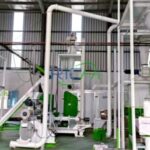




A modern organic fertilizer factory is not simply a room containing a pelletizer.
It is a coordinated production system designed to receive irregular agricultural materials and convert them into a standardized fertilizer product.
This distinction matters because manure can arrive in very different forms. Some material is wet and compact. Some contains long fibers or bedding. Some may need storage before processing. Other material can be relatively dry and easy to prepare.
A good factory therefore begins with raw-material management.
For businesses considering chicken manure pelleting equipment, the real project question is not only which machine can make pellets. It is how the entire plant should be structured so that every section supports the next one.
The First Section: Receiving and Storage
Every fertilizer plant needs a practical receiving area.
Raw manure should enter the factory in a controlled way rather than being unloaded randomly around the production building.
The receiving system may include hoppers, conveyors, temporary storage areas, or other handling equipment depending on project scale.
Storage is particularly important when supply and production schedules do not match.
For example, farms may deliver manure in concentrated batches, while the fertilizer factory operates continuously throughout the day.
Buffer storage helps balance these fluctuations.
The same principle applies to final products.
Finished pellets may need to remain in the warehouse until enough quantity has been accumulated for shipment.
The Preparation Stage Determines Downstream Stability
After receiving, the material needs to be prepared.
This may include removal of foreign matter, crushing, grinding, screening, or blending.
The purpose is to create a more predictable feedstock.
A production plant cannot expect the pelletizing section to compensate for highly inconsistent raw materials.
If one batch is wet and another is dry, the process may require constant adjustments.
A stable preparation section reduces this variation.
This is one of the strongest arguments for thinking about fertilizer production as a complete line instead of purchasing individual machines.
Drying Is Often the Largest Process Section
In many manure projects, moisture removal is the most technically demanding step.
The amount of water entering the plant directly affects dryer sizing and energy demand.
That means the project should begin with actual moisture data.
Suppose the same nominal output is planned for two factories.
One receives relatively dry processed manure.
The other receives freshly collected wet manure.
The second factory can require a much more substantial drying system even though the target pellet production rate is identical.
This is why capacity and moisture must always be discussed together.
Grinding and Particle Control
After drying, the material may need additional size adjustment.
A crusher or grinder can reduce larger particles and improve feed consistency.
However, there is no benefit in grinding more aggressively than the process requires.
The goal is a balanced particle distribution that works with the selected pelletizing technology.
For manure and organic fertilizer materials, this balance can also reduce excessive energy use.
The best equipment is not necessarily the machine that performs the most processing. It is the machine that performs the required processing efficiently.
Why Mixing Becomes More Important as Formulas Expand
A factory processing only one manure source may have a relatively simple material flow.
A commercial fertilizer producer may use multiple ingredients.
For example, manure could be combined with crop residues, mineral components, compost-derived material, or other organic matter to create products for different crops or markets.
Once the plant handles multiple formulations, the mixer becomes strategically important.
A good mixing process promotes uniform distribution.
That consistency can help the factory produce several commercial formulas without completely changing the plant.
Pelletizing Is Only One Part of Production
Once the feedstock has been prepared and conditioned, pelletizing forms the final particle shape.
The machine must receive material at a controlled rate and under suitable conditions.
This is where many production projects reveal whether upstream preparation was designed correctly.
If the material is too wet, the forming process becomes unstable.
If the mixture is inconsistent, pellet quality fluctuates.
If the feeder is not matched to the machine, production becomes irregular.
For this reason, the pelletizing section should be designed as part of the complete process flow.
(Related Post:https://www.richipelletmill.com/organic-fertilizer-pellet-machine/)
Where Does Cooling Fit?
Cooling follows pelletizing.
Fresh pellets need time to release heat and stabilize before entering packaging.
The cooling stage also contributes to overall process continuity.
A properly matched cooler can receive the output of the pelletizer without creating a new bottleneck.
The temperature of the pellets after cooling should be suitable for storage and packaging rather than simply “as low as possible.”
Again, balance is more important than maximum performance.
Screening Makes the Product More Consistent
Once cooled, pellets are normally screened.
The screen separates material according to size.
Commercially acceptable pellets continue to packaging.
Fine particles can often return to the production cycle.
Oversize pieces may be recycled depending on their condition.
This creates a more controlled finished-product stream.
For buyers, the visual difference can be significant.
A bag containing mostly consistent pellets is generally easier to market than one with large quantities of loose powder and broken material.
Packaging Is a Production Section, Not an Afterthought
A fertilizer plant that produces excellent pellets can still lose product value through poor packaging.
Bags must protect the pellets from moisture, dust, and handling damage.
Automatic weighing and packing may be useful for larger production volumes.
Smaller plants may use simpler systems.
The choice depends on sales channels.
A wholesale fertilizer distributor may prefer larger bags.
Retail customers may require smaller, branded packages.
Bulk sales may require a completely different loading system.
Therefore, packaging should be designed around the commercial model.
How a Complete Line Can Help Project Planning
A complete line concept makes it easier to understand production bottlenecks.
Suppose the pelletizer is rated for a certain output, but the dryer produces less.
The actual factory capacity is limited by the dryer.
Now consider a second project where drying is sufficient but screening is undersized.
Again, total output is constrained.
The purpose of a complete-line design is to create a balanced flow.
A supplier may therefore recommend a production configuration around a target such as a 1-4 T/H Organic Fertilizer Production Line, then calculate the supporting equipment based on the actual raw material and operating conditions.
This is much more practical than choosing each machine independently.
What About Combining Poultry and Other Manures?
Many fertilizer businesses do not rely on a single manure source.
A plant may process poultry manure, cow manure, and other organic materials depending on supply and product formulation.
This creates flexibility but also increases the importance of formulation management.
Different materials should be stored and identified separately where necessary.
The factory should know which formulation is being produced and which raw materials are being introduced.
This helps prevent accidental mixing of incompatible or unintended materials.
Which Customers Benefit from This Kind of Plant?
Potential users are not limited to fertilizer manufacturers.
Poultry farms may process their own manure.
Livestock farms may create fertilizer for internal agricultural use.
Agricultural cooperatives can centralize manure processing for members.
Fertilizer distributors can add locally sourced organic products to their portfolio.
Biomass and agricultural processing businesses may diversify into organic fertilizer.
The common factor is access to organic raw materials and a practical market for the finished fertilizer.
Why Project Layout Matters
The arrangement of machines can affect labor, safety, maintenance, and operating efficiency.
Material should ideally move through the factory in a logical sequence.
Raw materials come in.
Preparation follows.
Drying and conditioning take place.
Pelletizing forms the product.
Cooling and screening stabilize it.
Packaging completes it.
Finished products move to storage or dispatch.
When equipment is arranged around this flow, unnecessary material movement can be reduced.
Maintenance access should also be considered.
Machines need inspection space, cleaning access, and room for replacing wear parts.
A compact footprint is useful, but an overly crowded factory can make maintenance more difficult.
The Supplier’s Role in a Turnkey Project
For a multi-stage fertilizer plant, supplier responsibility can extend beyond machine manufacturing.
A technical supplier may contribute process design, equipment selection, layout planning, electrical integration, installation guidance, commissioning, operator training, and spare-parts support.
This is particularly useful for companies that have experience with agriculture but limited experience with industrial processing.
When researching suppliers, terms such as Richi pellet mill can help identify information about manufacturers and processing solutions.
Still, buyers should evaluate suppliers using practical criteria: process understanding, equipment compatibility, documentation, communication, and after-sales support.
What Makes a Plant Ready for Future Expansion?
Expansion should be considered before construction begins.
A factory may start with one pelletizing line but later add another.
Storage capacity may need to increase.
Packaging may become more automated.
Additional drying equipment may be added when new raw materials are introduced.
A well-planned layout leaves room for such changes.
Electrical capacity and utility planning can also include future demand where economically reasonable.
This allows the business to grow without completely redesigning the factory.
From Equipment Purchase to Production Strategy
A fertilizer factory should not be designed backward from a machine quotation.
The correct order is to define the business.
What raw material is available?
How much material arrives each day?
What moisture does it contain?
What fertilizer product will be sold?
Who will buy it?
How much can the market absorb?
How many operating hours are planned?
How much storage is required?
Once these questions are answered, the equipment configuration becomes much clearer.
For further reading on organic fertilizer machinery and process design, readers can look at this website and compare different approaches to manure processing and pellet production.
Why the Best Plant Is Not Always the Biggest
Large production capacity can be attractive on paper.
But a smaller, well-balanced plant may be more practical for a regional market.
The key is utilization.
A factory running efficiently at a realistic capacity can be more useful than a much larger factory operating far below its potential.
This is especially important in the early years of a fertilizer business.
The plant should be sized according to realistic raw-material supply, customer demand, energy availability, and working capital.
Expansion can come later as the market proves itself.
The Future of Manure Processing
Organic fertilizer manufacturing is closely connected to the wider trend of resource recovery.
Livestock production creates organic residues.
Crop production needs nutrients.
Processing technology creates a connection between the two.
Pelletizing adds another layer by making the material easier to handle, package, transport, and distribute.
The long-term opportunity is therefore larger than simply selling machinery.
It is about creating a practical system that converts agricultural by-products into standardized products.
That system requires engineering, process control, raw-material understanding, and commercial planning.
The pelletizer remains important, but it is only one part of the picture.
A modern manure fertilizer plant succeeds when all sections work together: receiving, storage, preparation, drying, grinding, mixing, pelletizing, cooling, screening, packaging, and logistics.
When the complete process is designed around the customer’s product and market, manure can move from being a difficult waste material to becoming a dependable agricultural resource.


