


Choosing Equipment for a Small Fish Feed Factory
Buying a small fish-feed production system involves more than selecting a machine with a suitable hourly output. The complete process needs to match the feed formula, raw materials, pellet size, available electricity, factory space, and expected production volume.
A small scale fish feed production plant for sale can range from a basic setup for farm use to a more automated system designed for commercial feed production. Understanding the differences between these configurations helps buyers prepare a more practical project specification.
Start With the Finished Feed
The first question is what type of feed the factory will produce.
Different fish species and growth stages can require different pellet sizes and formulas. A farm producing conventional sinking pellets may use a different process from a manufacturer producing floating extruded feed.
The desired finished product should therefore be defined before selecting the equipment.
For example, buyers should specify the target fish species, pellet diameter, feed type, daily requirement, and whether the product will be consumed on the farm or sold commercially.
Calculate the Required Capacity
Machine capacity should reflect actual production demand.
A small farm may only need several hundred kilograms of feed per day. In this situation, a compact production system can operate for a few hours and produce the required quantity.
A commercial producer with a larger customer base may need continuous operation and higher capacity.
Future growth should also be considered. If the farm expects to expand its ponds or begin selling feed, additional capacity can reduce the need for an early equipment replacement.
Which Machines Are Essential?
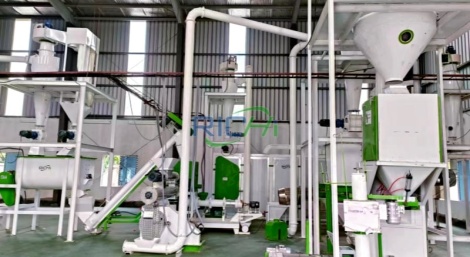
A conventional small fish-feed production system can include:
- Hammer mill
- Feed mixer
- Pellet mill
- Cooler
- Screener
- Conveyors
- Storage hopper
- Packing machine
The actual configuration depends on the raw materials.
If the ingredients already have a suitable particle size, the grinding section may be relatively simple. If the materials contain large particles, a stronger grinding system may be necessary.
Similarly, automatic packing is optional for a farm that consumes all of its own feed.
Why Is the Mixer Important?
The mixer creates a uniform distribution of feed ingredients before pelletizing.
This becomes especially important when a formula contains small quantities of vitamins, minerals, amino acids, or other additives. Proper mixing helps reduce variation between different portions of the batch.
A batch mixer is often suitable for smaller operations because it can process a defined quantity at a time.
For larger factories, automatic batching and continuous material handling can be introduced.
Choosing the Pelletizing Machine
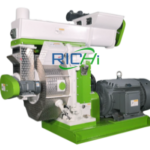
The pellet mill is one of the central machines in a conventional fish-feed production process.
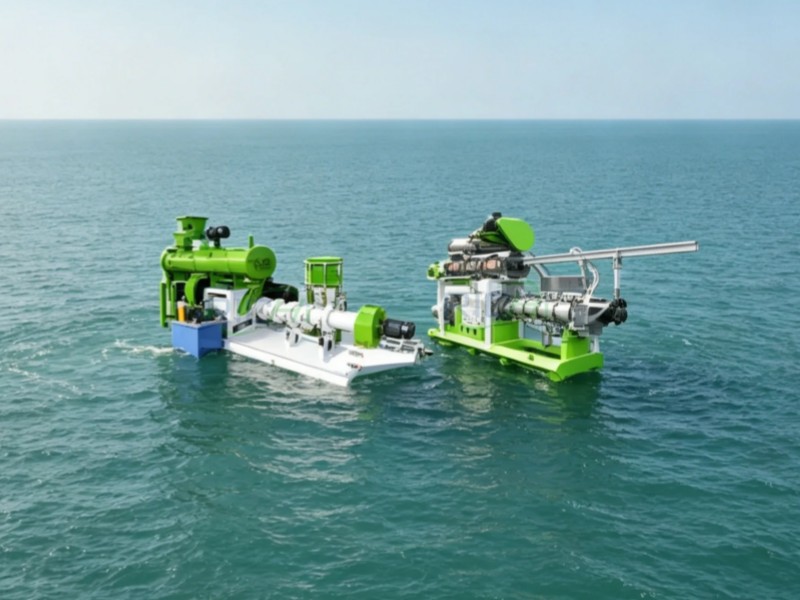
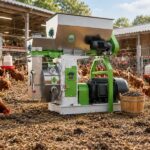
A fish feed pellet machine for small farms should be selected according to the required capacity, raw materials, pellet size, motor power, and operating schedule.
The die specification determines the approximate pellet diameter. Different fish species and growth stages may require different die sizes.
If a farm plans to produce several pellet sizes, interchangeable dies should be considered during equipment selection.
What About Cooling?
Fresh feed pellets normally leave the pelletizing chamber at elevated temperature. Cooling brings them closer to storage conditions and helps improve their physical stability.
After cooling, screening can separate excessive fines from finished pellets.
This step is particularly useful when the final product needs a consistent appearance and particle size.
Small systems can use compact cooling and screening equipment, while larger production lines can integrate these stages with automatic conveying.
Should the Factory Be Fully Automatic?
Not necessarily.
Automation should correspond to production volume and labor availability.
A basic plant can use manual feeding, weighing, and packing. This can keep the initial system relatively simple.
As output grows, automatic weighing, conveyors, storage bins, centralized controls, and automatic packing can be introduced.
A feed pellet machine can therefore operate as part of either a relatively simple farm-scale setup or a larger integrated production system, depending on the surrounding equipment.
Check the Electricity Supply
Electrical specifications should be confirmed before purchasing equipment.
Motor selection depends on voltage, frequency, phase, and available power. A factory should also consider whether the local electrical infrastructure can support the combined load of the grinder, mixer, pellet mill, cooler, conveyors, and other machines.
For projects in areas with limited electricity, the equipment configuration may need to be adjusted.
Consider the Factory Layout
The production line should allow materials to move in a logical sequence:
Raw Materials → Grinding → Mixing → Pelletizing → Cooling → Screening → Packing
The layout should leave sufficient space around each machine for operation, cleaning, die replacement, lubrication, and maintenance.
Raw-material storage should also be separated from finished-feed storage where practical.
What Information Should Buyers Send to a Supplier?
A detailed inquiry should normally include:
- Fish species
- Feed type
- Target pellet size
- Required capacity
- Main raw materials
- Feed formula, if available
- Raw-material moisture
- Voltage and frequency
- Factory dimensions
- Automation requirements
Providing representative raw-material samples can further help determine whether grinding, drying, or other preparation stages are necessary.
A small fish-feed factory does not need to start with the most complicated configuration. A properly matched system can provide the required output while leaving room for future expansion. click for more information about fish-feed equipment and complete production-system configurations.
Related Post: https://pelletizerequipment.com/sinking-fish-feed-machine/