

The cat litter market looks attractive from the outside. Demand is steady, repeat purchases are frequent, and the product does not spoil quickly. Pet ownership continues to rise in many regions, and cat owners buy litter month after month. For an entrepreneur looking for a manufacturing business with predictable demand, cat litter seems like a reasonable choice.
But entering this market is harder than it appears. Cat litter is a low-margin, high-volume product in many segments. Shipping costs matter enormously. Brand loyalty is real but fragile. A product that clumps poorly, generates dust, or fails to control odor will lose customers quickly, no matter how cheap it is. Small producers who succeed are usually the ones who understand their local market, control their raw material costs, and operate efficiently enough to compete with larger brands.
Understanding the Product Before the Plant
The biggest mistake new producers make is choosing equipment before understanding what they are actually selling. Cat litter is not one product. It is a category with several distinct segments, and each segment has different requirements.
Clumping clay litter dominates many markets. It relies on sodium bentonite that swells when wet and forms a firm clump. The key performance factors are clumping speed, clump strength, dust level, and tracking. A clump that breaks apart when scooped frustrates the customer. A litter that leaves paw prints across the house creates complaints. These are not minor issues. They determine whether a customer buys again.
Non-clumping litter is simpler. It absorbs liquid and controls odor, but it does not form clumps. It is often cheaper and appeals to budget-conscious buyers or those with very young kittens. The performance requirements are lower, but the price competition is fiercer.
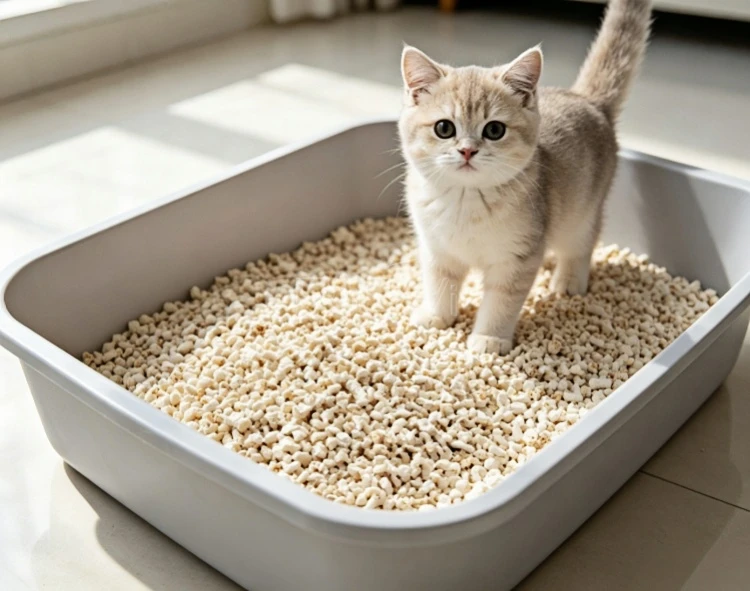
Crystal litter uses silica gel to absorb moisture and control odor. It lasts longer than clay but costs more. Production requires different equipment and a different raw material supply chain. Plant-based litter made from corn cob, wheat, peanut shell, or wood fiber appeals to environmentally conscious buyers. It is biodegradable, but it often absorbs less and costs more to produce.
A new producer should decide which segment to target before choosing a Cat Litter Manufacturing Line. The formula, the granule size, the packaging, and the marketing all follow from that decision. Trying to serve every segment at once usually means serving none of them well.
Raw Material Reality
Cat litter production lives or dies by raw material cost and availability. Bentonite is heavy and relatively cheap per ton, but transport can double the delivered cost if the mine is far from the plant. A producer located near a bentonite deposit has a structural advantage. One who must import bentonite by truck or ship faces a cost that never goes away.
Zeolite, diatomite, and sepiolite are used for odor control and absorption. They are often more expensive than bentonite. Blending them with bentonite can improve performance, but it raises cost. The producer must find the right balance between performance and price for the target market.
Plant-based materials have their own challenges. Corn cob and peanut shell are seasonal. Quality varies from batch to batch. Moisture content can be high. Storage requires protection from rain and pests. A producer who relies on agricultural by-products must plan for seasonal price swings and supply gaps.
Synthetic binders and additives add cost but can improve granule strength or clumping performance. Some producers use them sparingly. Others build their formula around them. The decision depends on the raw materials available and the performance the market demands.
The Equipment Chain
A cat litter line includes several machines working together. The granulator is the center, but it cannot function well without proper upstream and downstream equipment.
Crushing comes first. Raw materials must be reduced to a consistent particle size. A hammer mill or roller mill is typically used. The screen size determines the final particle size. Too coarse, and the granules will be weak. Too fine, and the material may not flow well through the granulator.
Mixing blends the materials uniformly. A ribbon mixer or paddle mixer is common. The mixing time and sequence matter. If the binder is added too early or too late, the blend may not be uniform. If the mixing time is too short, some granules will have more binder than others.
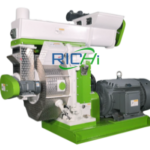
Granulation is the core step. A ring die granulator or flat die granulator presses the mixed material through a die. The die diameter determines the granule size. The compression ratio and die thickness affect granule hardness and density. The moisture content of the mix affects how well the material binds.
Drying removes excess moisture. A rotary dryer or belt dryer is common. The drying temperature and time must be controlled to avoid overdrying, which makes granules brittle, or underdrying, which leads to mold and caking.
Cooling brings the granules to ambient temperature. A counterflow cooler or belt cooler is used. Warm granules sweat in the bag, causing moisture migration and quality problems.
Screening separates granules by size. A vibrating screen is typically used. Oversized granules can be crushed and recycled. Fines are returned to the mixer. The screening system should be efficient enough to keep the final product within the target size range.
Dust collection is essential. Cat litter dust is a health hazard for workers and a quality problem for customers. A bag filter or cyclone system should be installed at crushing, mixing, granulation, drying, cooling, and packaging points.
Packaging is the final step. The bag must protect the product from moisture and handling damage. The filling system should be accurate. The bag design should reflect the brand and the target market. A premium product needs a premium package. A budget product needs a low-cost package that still protects the contents.
What 2 Tons Per Hour Means in Practice
A 2t/h Cat Litter Manufacturing Line for sale is a mid-scale operation. It can produce roughly 16 tons per shift, or 32 to 48 tons per day if run in two or three shifts. That is enough to supply a regional market, a chain of pet stores, or a private label contract.
But two tons per hour is not a small operation. It requires serious infrastructure. The plant needs reliable power, a steady water supply, adequate raw material storage, and a trained workforce. It needs a dust collection system that meets local regulations. It needs a loading area that can handle trucks. It needs working capital to buy raw materials and carry inventory.
The investment in supporting equipment can easily exceed the cost of the granulator itself. A producer who budgets only for the main machine will run out of money before the plant is complete. The total project cost should include land, buildings, utilities, installation, commissioning, spare parts, training, and working capital.
Market Positioning and Pricing
Cat litter is sold through several channels: supermarkets, pet specialty stores, online marketplaces, veterinary clinics, and direct-to-consumer subscriptions. Each channel has different requirements for packaging, pricing, and promotion.
Supermarkets want attractive packaging and competitive pricing. Pet specialty stores want performance and brand story. Online marketplaces want strong reviews and fast shipping. Direct-to-consumer subscriptions want convenience and repeat purchase incentives. A new producer should choose one or two channels to start, not try to serve all of them at once.
Pricing is a strategic decision, not just a cost calculation. A premium product can command a higher price if it delivers better performance. A budget product must be cheap enough to attract price-sensitive buyers but still cover costs. Many new producers price too low, hoping to win market share. That strategy rarely works in a category where customers buy repeatedly. If the product performs well, they will pay a fair price. If it performs poorly, no price is low enough.
Quality Control and Consistency
Consistency is the hardest part of cat litter production. Raw materials vary. Equipment wears. Operators change. A batch that performs well one week may perform differently the next. Customers notice.
Quality control should start with incoming materials. Moisture, particle size, and purity should be checked. Bentonite from different suppliers or different parts of the same mine can behave differently. The producer must know what they are buying.
In-process checks keep the line on track. Granule hardness, size distribution, moisture content, and dust level should be monitored. Simple tests can be done in-house. A tumbler or shaker can test durability. A sieve can check size distribution. A moisture meter can check drying. These tests do not replace laboratory analysis, but they catch problems before they reach the customer.
Finished product should be sampled and stored correctly. Bags should be stacked on pallets, away from walls and floors. The storage area should be dry and ventilated. Stock should be rotated so older product is used first. In humid climates, extra care is needed to prevent caking and mold.
Common Mistakes New Producers Make
Several mistakes appear repeatedly in small cat litter projects.
Choosing the wrong granule size. Granule size affects clumping, tracking, and absorption. Too small, and the litter tracks everywhere. Too large, and it may not clump well. The right size depends on the target market.
Ignoring dust. Dust is the most common customer complaint. It should be controlled at the source, not filtered out after the fact. Proper moisture control, gentle conveying, and effective screening reduce dust.
Undersizing the dryer. A dryer that cannot keep up with the granulator forces the line to run slower or produces wet granules. Both outcomes hurt profitability.
Skipping maintenance. Dies and rollers wear out. Bearings fail. Screens tear. A plant that does not plan for maintenance will face downtime and poor quality.
Underestimating working capital. Raw materials must be purchased before product is sold. Inventory sits in the warehouse. Customers expect payment terms. A plant that runs out of cash cannot operate, no matter how good the equipment is.
Working With Equipment Suppliers
The equipment supplier matters as much as the equipment itself. A good supplier understands cat litter production, not just granulation. They ask about raw materials, target granule size, and performance requirements. They provide layouts, utility requirements, and training recommendations. They support the plant after commissioning.
Producers looking at a pellet production line for cat litter should ask whether the supplier has experience with their specific materials. Bentonite behaves differently from feed ingredients. Zeolite behaves differently from bentonite. Plant fibers behave differently from minerals. A supplier who has only built feed lines may not anticipate these differences.
It also helps to visit a running plant if possible. Seeing a similar operation can reveal practical issues that are not visible in a catalog. How is the material fed? How often is the die changed? How is dust controlled? How are fines handled? These details matter more than glossy photos.
A Realistic Path Forward
Entering the cat litter market is possible for a small business, but it requires planning and discipline. The successful path usually looks like this:
Start with market research. Understand the local demand, the competing products, and the price points. Decide which segment to target.
Secure raw materials. Find reliable suppliers and negotiate prices. Test the materials before committing to a formula.
Design the process. Match the equipment to the product and the scale. Do not overbuild, but do not undersize the supporting equipment.
Plan the layout. Material flow, storage, dust control, and safety should all be considered.
Train the team. Operators need to understand the process, not just push buttons. Maintenance staff need to know how to replace dies, rollers, and bearings.
Test and refine. Run trials. Check quality. Adjust the formula and process as needed. Gather feedback from customers.
Scale gradually. Start with a capacity you can sell. Add shifts or equipment as demand grows. Do not invest in a large line before the market is proven.
Conclusion
The cat litter market offers real opportunities for small and mid-size producers, but it is not an easy business. Raw material costs, dust control, granule quality, and market positioning all determine success. A Cat Litter Manufacturing Line is a tool, not a guarantee. A 2t/h Cat Litter Manufacturing Line for sale can be the foundation of a profitable operation, but only if the producer understands the product, the process, and the market.
For those who take the time to plan properly and operate carefully, cat litter production can be a sustainable business. For those who rush in without understanding the material and the customer, it can be an expensive lesson. The difference lies in the preparation, not the equipment.